🇦🇺 Research Visit at Swinburne University of Technology, Melbourne
From September 20 to October 18, I spent four weeks at the Swinburne University of Technology in Melbourne, working under the supervision of Dr. Themiya Nanayakkara, who served as my host for this collaborative visit. The fellowship provided an invaluable opportunity to pursue new research directions, exchange ideas with leading experts, and strengthen international collaborations in astrophysics. The visit also allowed me to experience a vibrant academic environment in Australia and to explore the broader research landscape of observational astronomy across several institutions.
During this visit, I initiated several research projects that will continue to develop beyond the fellowship period. The first project, in collaboration with Dr. Themiya, focuses on studying the population of Lyman-alpha emission galaxies at redshifts between 3 and 6 using public JWST NIRSpec data. This work extends my long-standing interest in high-redshift galaxy formation and evolution. We began by cross-matching MUSE catalogs of Lyman-alpha emitters from the AMUSED and MUSE-WIDe surveys with sources in the DAWN DJC database that have corresponding NIRSpec spectra. The analysis centers on Hα and Hβ emission lines in these galaxies, from which we can derive Balmer decrements to correct for dust extinction. By investigating the correlation between the Lyman-alpha and Balmer line fluxes, we aim to constrain how the escape of Lyman-alpha photons is influenced by dust, gas geometry, and the interstellar medium’s physical conditions. This project not only combines spectroscopic data from multiple observatories but also highlights how public JWST datasets can be leveraged for new science. Our preliminary work has already identified several promising sources, and we plan to prepare a publication once the analysis is complete.
The second project builds upon my background in galaxy cluster research, connecting my expertise with the resources available at Swinburne. Together with Dr. Lalitwadee Kawinwanichakij, a postdoctoral researcher in Professor Karl Glazebrook’s group, I began analyzing JWST NIRCam images to study the morphology of galaxies in clusters. Our goal is to investigate three clusters at redshifts between 0.6 and 1.2 that have publicly available NIRCam imaging. I learned to access, process, and combine calibrated JWST data across multiple filter bands using the JWST calibration pipeline and specialized Python tools for photometric analysis. We then performed structural decomposition of galaxies into disk and bulge components using two-dimensional Sérsic profile fitting. Preliminary results from one cluster observed in the F150W filter suggest a possible correlation between the Sérsic index and projected cluster-centric distance. In future work, we will control for stellar mass to test whether this trend is genuine or driven by underlying population differences. This project has also provided me with valuable experience working with JWST imaging data, which will benefit my future research on galaxy evolution in dense environments.
In addition to these main projects, I had the opportunity to engage with the Evolutionary Map of the Universe (EMU) collaboration. During discussions with the EMU project director, I was invited to join this open collaboration, which utilizes the ASKAP radio telescope to conduct a deep all-sky survey of the southern sky. Following my induction, I began a joint project with Dr. Nikhel Gupta from CSIRO Space & Astronomy to investigate the radio properties of central galaxies in clusters. The goal is to compare the radio activity of brightest cluster galaxies with that of satellite and field galaxies, exploring the role of environment and feedback in triggering radio emission. This project directly connects to my previous work on radio AGN in galaxy clusters and will form the basis of a long-term collaboration with Australian radio astronomers. I also had the chance to discuss future possibilities for cross-comparison between ASKAP data and optical cluster catalogs from DES and ACT, which may lead to a larger multiwavelength study in the near future.
Beyond research, I participated in academic activities within Swinburne’s astronomy program. I gave a tutorial lecture on how to use TOPCAT, an interactive graphical software widely used in astronomy for exploring, analyzing, and visualizing tabular data. The session introduced students and researchers to practical techniques for handling large astronomical catalogs, including visualization of correlations and efficient cross-matching of multiwavelength datasets. The tutorial was well received and sparked discussions about integrating such tools into Swinburne’s graduate courses. This teaching experience allowed me to share my expertise while also improving my ability to communicate technical knowledge to an international audience.
Throughout my stay, I was invited to present my research in seminars and colloquia at four institutions: the Australia Telescope National Facility (ATNF) headquarters in Sydney, Macquarie University, Swinburne University of Technology, and the University of Melbourne. These talks allowed me to share my ongoing work on galaxy clusters and radio AGNs while receiving valuable feedback from faculty members and researchers. The discussions that followed each presentation provided new perspectives on data analysis and interpretation, and they opened possibilities for future collaborative projects. I had stimulating conversations with many prominent astronomers, including Dr. Bärbel Koribalski (CSIRO), Prof. Matt Owers and Prof. Andrew Hopkins (Macquarie University), Prof. Scott Croom (University of Sydney), and Prof. Christian Reichardt (University of Melbourne), as well as numerous postdoctoral fellows and graduate students. These interactions significantly broadened my academic network and deepened my understanding of current research directions in Australian astronomy.
This fellowship also offered an excellent opportunity to connect with Thai astronomers working and studying in Australia. In addition to collaborating closely with Dr. Lalitwadee Kawinwanichakij at Swinburne, I met two Thai PhD students: Ms. Sujeeporn Tuntipong at the University of Sydney and Mr. Tong Cheunchitra at the University of Melbourne. Meeting Thai researchers abroad gave me great pride and inspiration, as we shared experiences and discussed potential ways to strengthen research ties between Thai and Australian institutions. I believe these personal and professional connections will lead to future collaborations that help build the next generation of Thai astrophysicists.
Outside of academic activities, I also had the opportunity to explore Australia’s rich culture and natural beauty. During weekends, I visited several iconic landmarks such as the Sydney Opera House, the Melbourne State Library, the Royal Botanic Gardens Victoria, the Melbourne Cricket Ground (MCG), and the colorful Brighton Beach. Experiencing the blend of modern city life and natural scenery in Australia gave me a broader perspective on life outside academia, providing a refreshing balance to the intensive research schedule. These moments of exploration and reflection were invaluable, as they helped renew my creativity and motivation toward research.
Overall, this fellowship has been an exceptionally productive and inspiring experience. It allowed me to initiate new research projects, expand my technical skills in JWST and ASKAP data analysis, and form long-lasting collaborations with researchers in Australia. The visit also strengthened my international presence as an early-career researcher and provided valuable teaching and outreach experience. I am deeply grateful for the support that made this visit possible and look forward to continuing the projects and collaborations that have emerged from it. Photos documenting my research activities and visits during the fellowship are attached at the end of this report.
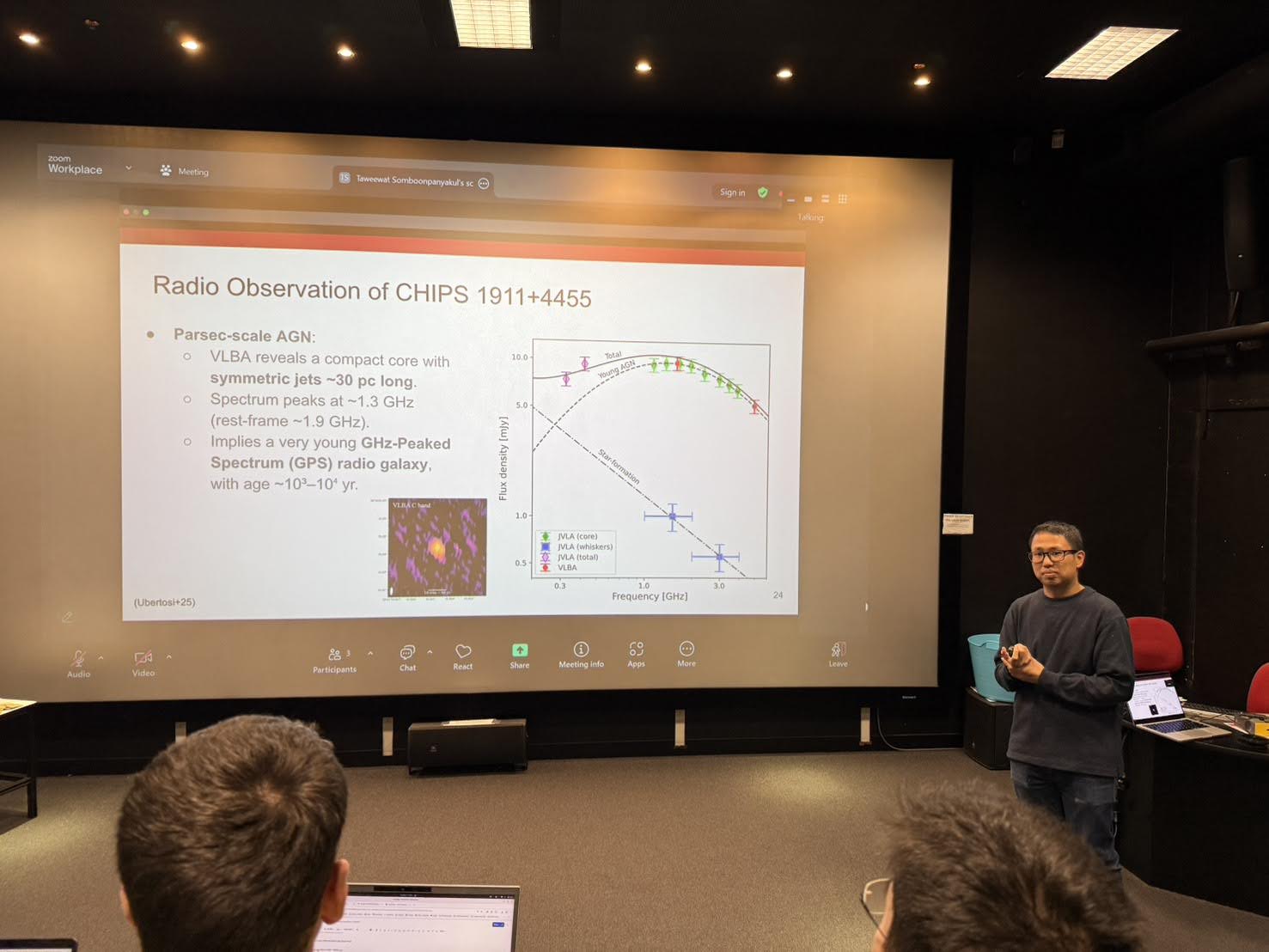
Sharing my research of galaxy clusters at CAS (Center for Astrophysics and Supercomputing) Colloquium at Swinburne University of Technology.
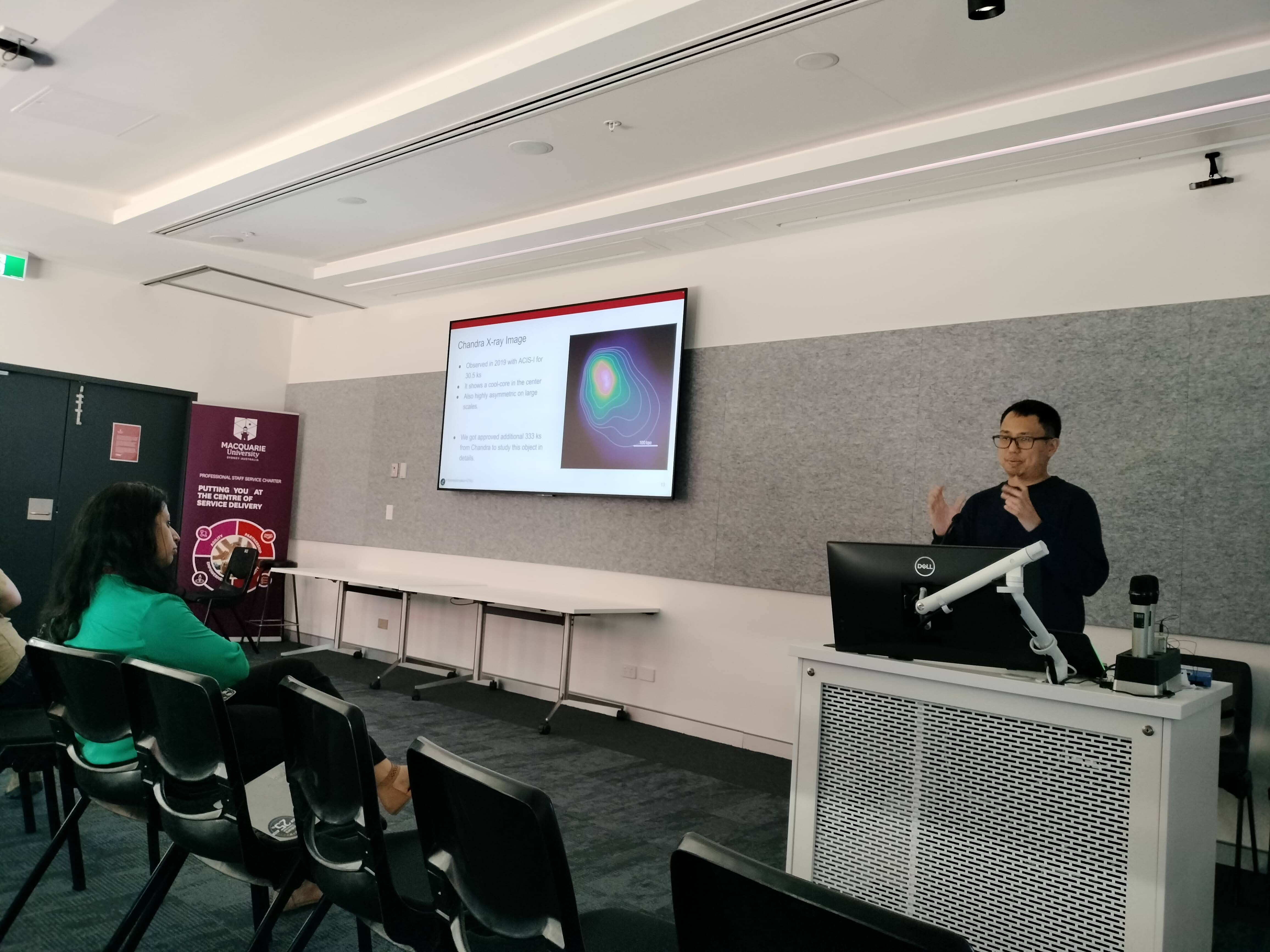
Delivering a talk on multiwavelength studies of brightest cluster galaxies to faculty members and students at Macquarie University. (
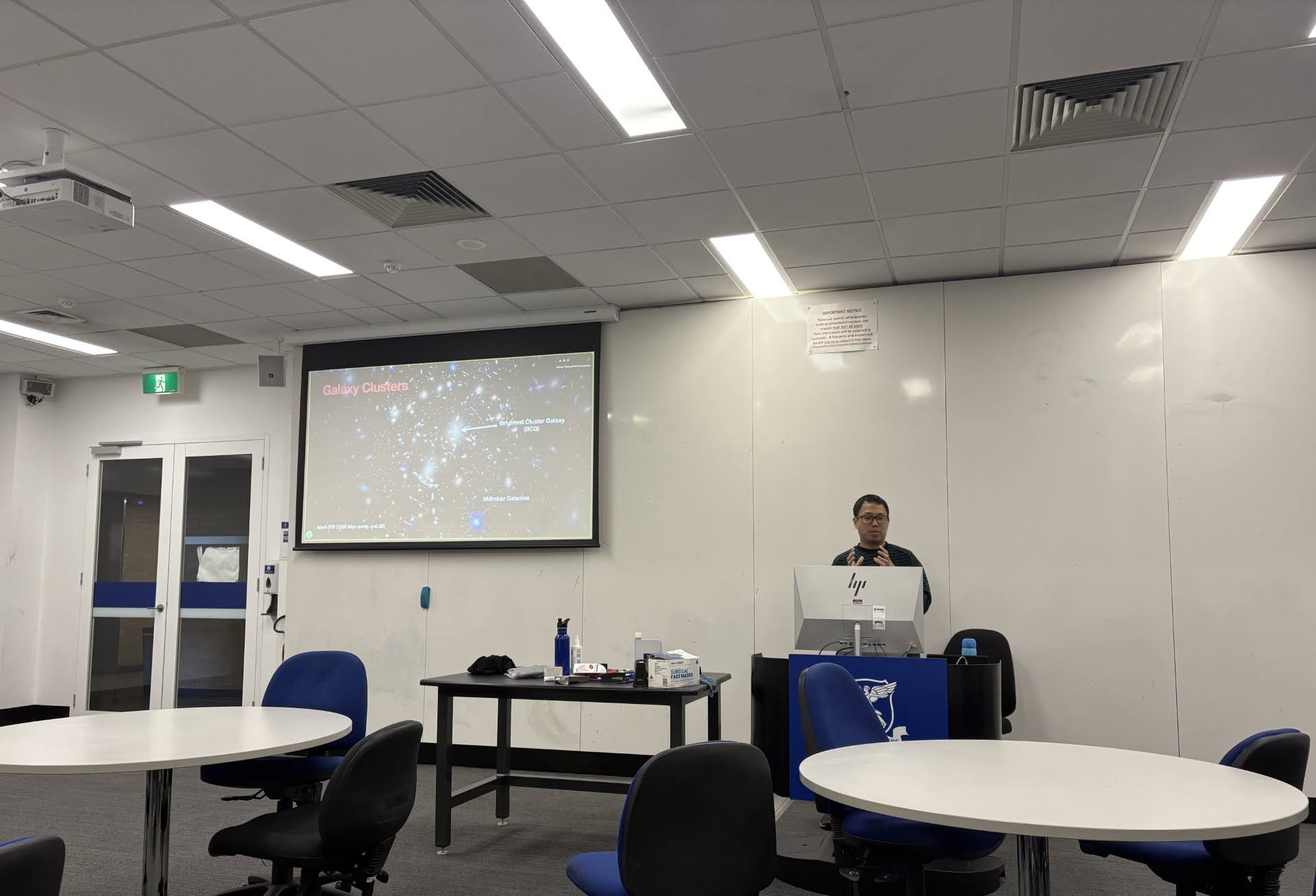
Presenting an overview of my ongoing collaborative projects on galaxy clusters to researchers and graduate students at the University of Melbourne.
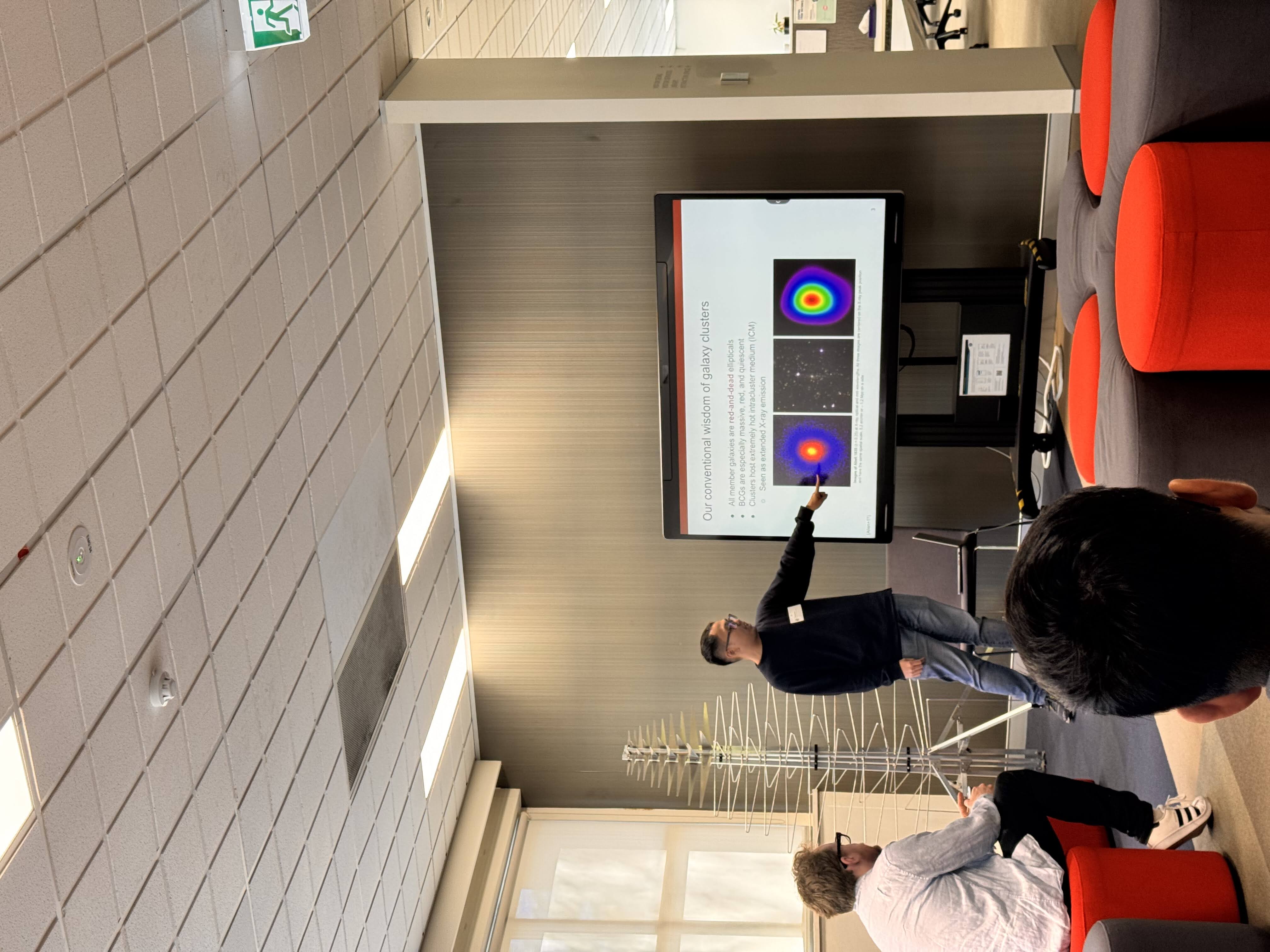
Presenting my research on radio properties of galaxy clusters to researchers and staff at ATNF headquarters.
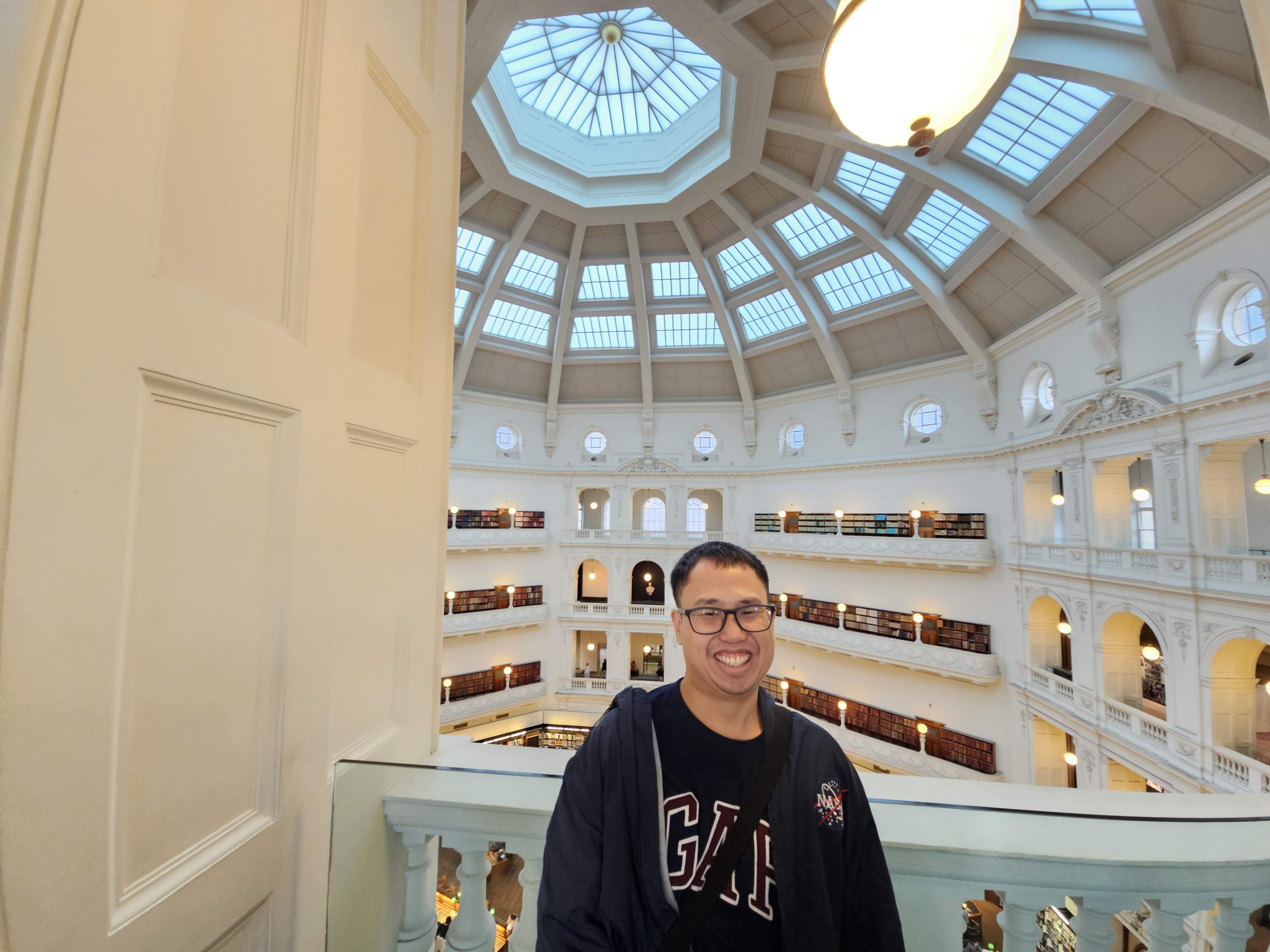
Exploring the historic State Library Victoria, a cultural and architectural centerpiece of Melbourne, during my free time on weekends.
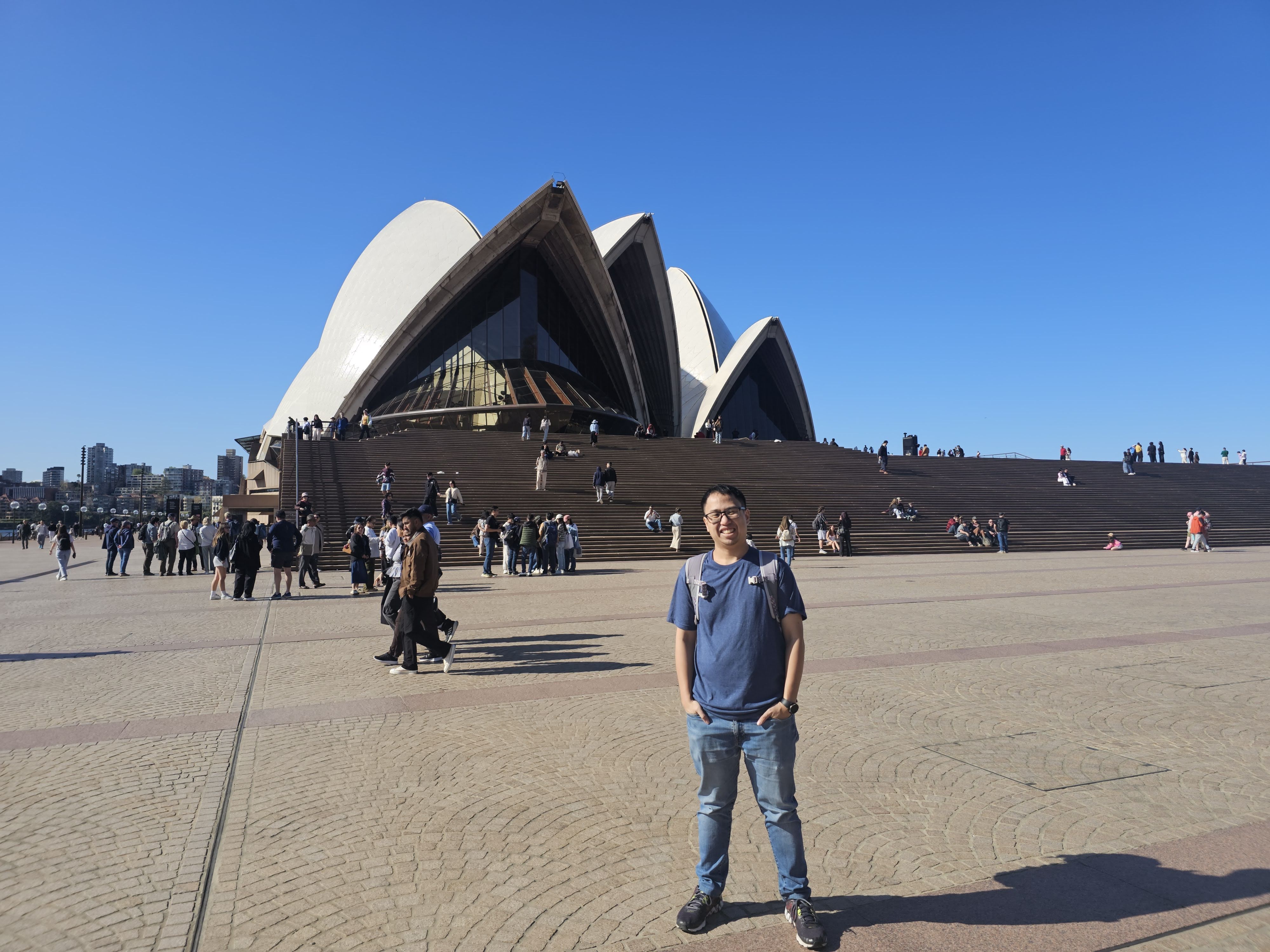
Visiting one of Australia’s most iconic landmarks during my stay, with its distinctive architecture overlooking Sydney Harbour.